The best surround sound speaker systems with Dolby Atmos make movies, shows, and games feel more immersive by placing sound around and above you. This roundup compares ten systems across soundbar packages, wireless theater kits, and traditional AV receiver setups.
Use the buying guide below to match channel count, speaker layout, connectivity, and room size to the experience you want—without paying for features your space cannot use.
Best 10 Surround Sound Speaker Systems with Dolby Atmos Picks for 2026
Best Balanced Setup
TCL S65K 5.1 Dolby Atmos Soundbar System

- 5.1 channels with Dolby Atmos and DTS:X
- Wireless surrounds and 6.5-inch subwoofer
- AI auto room calibration and clear dialogue
Best For: Easy living-room surround sound with flexible wireless speakers
Best for Maximum Immersion
ULTIMEA Skywave X100 9.1.6 System

- 9.1.6 channels with six dedicated height channels
- Four wireless surrounds and dual 5GHz transmission
- 10-inch subwoofer with 20Hz low-frequency extension
Best For: Dedicated home theaters wanting expansive overhead effects
Best Bass-Focused Option

- Dual wireless 10-inch subwoofers
- Four modular surround speakers
- HDMI eARC, three HDMI inputs, and 4K HDR pass-through
Best For: Cinematic movies and gaming with powerful room-filling bass
Best Fully Wireless Upgrade

- 7.1.4 channels with overhead Dolby Atmos effects
- Dual 5GHz wireless transmission
- 10-inch subwoofer and customizable app controls
Best For: Wireless home theaters wanting height effects and tuning flexibility
Immersive Horn-Loaded Value
Klipsch Reference Cinema 5.1.4

- Four Atmos satellite speakers create front and rear height effects
- Tractrix horns and aluminum tweeters emphasize high-frequency detail
- Powered subwoofer and center channel included
Best For: Wired movie-focused home theaters
Wireless Cinematic Power

- Dual 5GHz transmission reduces speaker-wire clutter
- 5.1.4 channels deliver surround and overhead effects
- 8-inch subwoofer and 760W peak power target deep, forceful bass
Best For: Wireless home theaters with strong bass
Flexible AV Hub
Yamaha YHT-4970U Dolby Atmos System
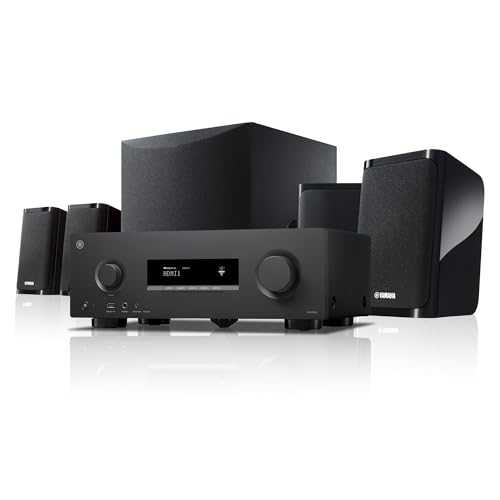
- Includes receiver, five speakers, powered subwoofer, and cables
- Supports Dolby Atmos plus 4K/120 and 8K/60 video
- Room correction and Bluetooth Multipoint simplify setup and use
Best For: Gamers and complete wired home theaters
Best Height-Channel Value

- 5.1.2 channels with rear and up-firing speakers
- HDMI eARC supports lossless Dolby Atmos
- App includes 10-band EQ and 121 presets
Best For: Home theaters prioritizing overhead Atmos effects and tuning flexibility
Best Full-Room Coverage

- 7.1 channels include two front and two rear speakers
- 6.5-inch wireless subwoofer adds flexible bass placement
- HDMI eARC, optical, and AUX inputs are included
Best For: Larger rooms needing broad surround coverage and flexible connectivity
Best Simple Setup

- Built-in five-speaker layout needs no rear speakers
- 300W peak output with a dedicated wired subwoofer
- HDMI eARC and Bluetooth 5.4 support
Best For: Smaller setups wanting Atmos sound without separate rear speakers
Best Balanced Setup – TCL S65K 5.1 Dolby Atmos Soundbar System
For shoppers comparing surround sound speaker systems with dolby atmos, the TCL S65K offers a practical 5.1-channel package with a soundbar, wireless subwoofer, and wireless surround speakers. Dolby Atmos and DTS:X support add height and rear effects, while AI Sonic auto room calibration helps tailor playback to your space.
Best For: Living rooms that need an easy, flexible surround setup with clear dialogue and wireless rear speakers.
Pros:
- Includes Dolby Atmos, DTS:X, wireless surround speakers, and a wireless 6.5-inch subwoofer.
- AI Sonic auto room calibration adjusts the sound for the listening space.
- Built-in center-channel speaker and tweeter support clear dialogue and detailed highs.
- Supports Bluetooth, USB, Wi-Fi, and HDMI connectivity.
Cons:
- Its 5.1-channel design is less expansive than larger systems with dedicated height channels.
- The 6.5-inch subwoofer may provide less low-end impact than systems with larger subwoofers.
The S65K is a sensible all-in-one choice when straightforward setup and wireless surrounds matter more than maximum channel count. Its calibration and dialogue-focused design make it especially appealing for everyday movies, TV, music, and gaming.
Best for Maximum Immersion – ULTIMEA Skywave X100 9.1.6 System
Among surround sound speaker systems with dolby atmos, the ULTIMEA Skywave X100 stands out for its 9.1.6-channel architecture, six dedicated height channels, four wireless surround speakers, and wireless subwoofer. Its dual 5GHz connection is designed for synchronized multi-channel playback without speaker-to-speaker audio cables.
Best For: Dedicated home theaters seeking extensive overhead and rear-channel coverage without an external AV receiver.
Pros:
- 9.1.6-channel layout includes six dedicated height channels for compatible Dolby Atmos and DTS content.
- Four wireless surround speakers and dual 5GHz transmission reduce cable clutter.
- 10-inch wireless subwoofer is engineered for low-frequency extension down to 20Hz.
- Independent surround-level control helps accommodate different room layouts and seating positions.
Cons:
- The larger multi-speaker configuration requires more placement space than a basic soundbar system.
- Its advanced feature set may be more than casual TV listeners need.
With THX-tuned audio, substantial DSP processing, and a high channel count, the Skywave X100 is built for shoppers prioritizing an expansive, theater-style presentation. It is best suited to rooms where the additional surround and height speakers can be positioned effectively.
Best Bass-Focused Option – Nakamichi Shockwafe 9.2.4
The Nakamichi Shockwafe 9.2.4 is a strong contender among surround sound speaker systems with dolby atmos, pairing Dolby Atmos and DTS:X with four modular surround speakers and dual wireless 10-inch subwoofers. It also provides HDMI eARC, three HDMI inputs, and 4K HDR and Dolby Vision pass-through for a flexible home theater connection setup.
Best For: Movie and gaming enthusiasts who want powerful, room-filling bass and a broad surround presentation.
Pros:
- Dual wireless 10-inch subwoofers deliver substantial low-frequency output.
- Four modular surround speakers create a wide 360-degree sound field.
- HDMI eARC, three HDMI inputs, 4K HDR, and Dolby Vision pass-through support modern sources.
- Offers aptX HD Bluetooth plus optical, coaxial, and 3.5mm connectivity.
Cons:
- Each surround speaker connects to a subwoofer with an RCA cable, so the surround speakers are not fully wireless.
- The dual-subwoofer package is large and weighs 80 pounds overall.
- Its tabletop-oriented setup may require more room than a compact soundbar package.
The Shockwafe is a compelling fit when bass impact and connection flexibility are priorities. Its modular surrounds allow placement versatility, but buyers should plan for the system’s substantial size and the required RCA connections.
Best Fully Wireless Upgrade – ULTIMEA Skywave X70 7.1.4
The ULTIMEA Skywave X70 gives shoppers considering surround sound speaker systems with dolby atmos a 7.1.4-channel design with wireless transmission, a 10-inch subwoofer, and dedicated height effects. Its app adds a 10-band EQ, 121 sound presets, and over-the-air updates for more control after installation.
Best For: Viewers who want a modern wireless surround setup with strong bass and app-based sound customization.
Pros:
- 7.1.4-channel configuration supports immersive horizontal, rear, and overhead effects.
- Dual 5GHz wireless transmission is designed to reduce interference and dropouts.
- 10-inch wireless subwoofer is rated for bass extension down to 20Hz and up to 980W peak output.
- App connectivity provides a 10-band EQ, 121 presets, and OTA updates.
Cons:
- The system’s multiple speakers and subwoofer require more room than a standalone soundbar.
- Its feature-rich app and processing controls may be unnecessary for users seeking simple plug-and-play operation.
The Skywave X70 balances a higher-channel immersive layout with fully wireless connectivity and extensive tuning options. It is a practical middle ground for buyers who want more height realism than a 5.1 system without moving to the X100’s larger 9.1.6 arrangement.
Immersive Horn-Loaded Value – Klipsch Reference Cinema 5.1.4
The Klipsch Reference Cinema Dolby Atmos 5.1.4 System is a strong choice for shoppers seeking surround sound speaker systems with Dolby Atmos in a traditional wired home-theater setup. Four Atmos-equipped satellite speakers create height effects from both the front and rear, while the included center channel and powered subwoofer complete the package.
Best For: Movie-focused home theaters that prioritize a 360-degree listening experience and horn-loaded high-frequency detail.
Pros:
- Four satellite speakers provide front- and rear-height Dolby Atmos effects.
- Tractrix horn technology and aluminum tweeters support extended high-frequency response.
- Built-in digital subwoofer amplification delivers powered low-end output.
- Includes a center channel, satellite speakers, and subwoofer in a six-piece system.
Cons:
- Wired connectivity requires more setup and cable management.
- The system does not include wireless communication technology.
- Its 300-watt maximum output may be less suitable for very large rooms.
Choose this Klipsch system if you want dedicated Atmos speakers positioned around the room and appreciate a recognizable horn-speaker presentation. Its wired design is less convenient than wireless alternatives, but it offers a straightforward, component-based home theater package.
Wireless Cinematic Power – ULTIMEA Skywave X50 5.1.4
The ULTIMEA Skywave X50 is designed for shoppers who want surround sound speaker systems with Dolby Atmos without running speaker wires throughout the room. Its wireless 5.1.4 configuration combines height effects, dual 5GHz transmission, a large subwoofer, and a soundbar-based design for a room-filling home theater experience.
Best For: Users who want a powerful wireless Atmos setup with deep bass and app or remote control.
Pros:
- Dual 5GHz wireless transmission supports a cable-reduced surround setup.
- 5.1.4-channel design adds overhead effects for immersive movie sound.
- 8-inch subwoofer and Gravus technology are specified to reach down to 28Hz.
- 760 watts of peak power and 4K HDR pass-through suit cinematic viewing.
Cons:
- Wireless performance can still depend on room layout and interference conditions.
- The system is not waterproof or designed for outdoor use.
- Its soundbar-and-subwoofer format may not suit shoppers seeking separate traditional speakers.
The Skywave X50 stands out when easy placement, strong bass, and wireless convenience matter most. Its advanced processing and 5.1.4 layout target an expansive presentation, while the contemporary metal-and-wood design gives the system a more decorative presence.
Flexible AV Hub – Yamaha YHT-4970U Dolby Atmos System
The Yamaha YHT-4970U is an all-in-one option for shoppers comparing surround sound speaker systems with Dolby Atmos and modern video connectivity. The package includes a Dolby Atmos AV receiver, five speakers, a powered subwoofer, speaker wire, and setup accessories, along with support for 4K/120 and 8K/60 sources.
Best For: Gamers and home-theater users who need a complete wired system with advanced HDMI features and automatic room correction.
Pros:
- Complete package includes the receiver, five speakers, powered subwoofer, cables, and setup microphone.
- Dolby Atmos and DTS Virtual:X support dimensional surround sound.
- 4K/120, 8K/60, Dolby Vision, HDR10+, ALLM, and VRR support modern video and gaming needs.
- Automatic room correction adjusts performance using the included microphone.
Cons:
- The listed speaker configuration is 5.1 rather than a discrete 5.1.4 speaker layout.
- Wired speakers require installation and cable routing.
- The receiver-based setup may take more configuration than a soundbar system.
This Yamaha package is a practical choice when the receiver is as important as the speakers. It offers broad source compatibility, room correction, Bluetooth Multipoint, and an included setup guide, making it well suited to mixed movie, music, and gaming systems.
Best Height-Channel Value – ULTIMEA Skywave F40 5.1.2ch
For shoppers comparing surround sound speaker systems with Dolby Atmos, the ULTIMEA Skywave F40 stands out with a dedicated 5.1.2-channel layout, up-firing drivers, rear speakers, and a wired subwoofer. HDMI eARC is included for lossless Dolby Atmos transmission, while app-based tuning makes it easier to adjust the system to your room.
Best For: Viewers who want overhead Atmos effects and detailed audio controls in a compact home-theater setup.
Pros:
- 5.1.2-channel design combines rear surround speakers with up-firing Atmos drivers.
- HDMI eARC supports lossless 5.1.2-channel audio and CEC synchronization.
- App offers a 10-band EQ, 121 presets, OTA updates, and adjustable surround levels.
- VoiceMX technology is designed to improve dialogue clarity.
Cons:
- Does not support DTS.
- The subwoofer is wired rather than wireless.
- It is not water resistant.
The Skywave F40 is a strong choice when height effects are a priority. Its up-firing driver design and eARC connection target more precise, full-bandwidth Atmos playback, while the extensive app controls give listeners plenty of room to personalize the sound.
Best Full-Room Coverage – ULTIMEA Poseidon D80 7.1
The ULTIMEA Poseidon D80 is one of the more expansive surround sound speaker systems with Dolby Atmos, using a 7.1-channel arrangement with two front and two rear speakers. Its 6.5-inch wireless subwoofer, 4K HDMI eARC connection, and app-based EQ controls make it suited to larger, more immersive entertainment setups.
Best For: Movie and gaming rooms where a broad front-to-back sound field and stronger bass are priorities.
Pros:
- 7.1-channel system uses two front and two rear speakers for wider coverage.
- 6.5-inch wireless subwoofer supports a more flexible installation.
- HDMI eARC supports 4K connectivity, with optical and AUX inputs for older devices.
- App includes 121 presets, multiple listening modes, custom EQ, and OTA updates.
Cons:
- Does not support DTS decoding.
- The larger multi-speaker layout may require more setup space and cable management.
The Poseidon D80 is the most room-filling option in this group. Its extra front and rear speakers emphasize spatial coverage, while the wireless subwoofer and multiple inputs offer practical installation flexibility for a dedicated media space.
Best Simple Setup – ULTIMEA Poseidon M60 5.1ch
For an easier entry into surround sound speaker systems with Dolby Atmos, the ULTIMEA Poseidon M60 uses five built-in speakers and side-firing drivers instead of separate rear speakers. It pairs a 300W peak output with a wired wooden subwoofer, HDMI eARC, Bluetooth 5.4, and a setup designed to take less than a minute.
Best For: TV owners who want wider Atmos sound and substantial bass without installing rear speakers.
Pros:
- Five built-in speakers and side-firing drivers create wide surround without rear speakers.
- 300W peak output and a dedicated 5.25-inch wired subwoofer provide room-filling sound.
- VoiceMX technology is designed to keep dialogue clear at lower volumes.
- HDMI eARC, Bluetooth 5.4, app controls, and remote control are included.
Cons:
- It does not provide the separate rear-speaker placement of the other systems.
- The subwoofer is wired.
- It is not water resistant.
The Poseidon M60 makes the most sense for a straightforward installation. Its built-in speaker layout avoids rear-speaker placement while still adding Dolby Atmos processing, and the wired subwoofer gives the system a stronger low-end foundation for movies and music.
How We Picked the Best Surround Sound Speaker Systems with Dolby Atmos
We selected systems that offer a meaningful path to surround sound and Dolby Atmos, then compared their speaker configurations, amplification, connectivity, subwoofer design, installation requirements, and intended room size. The list includes compact soundbar systems, expandable wireless packages, and conventional receiver-based home theaters so shoppers can compare convenience with control.
We also considered practical details such as HDMI eARC support, 4K or 8K passthrough, wireless speaker placement, Bluetooth playback, included subwoofers, and whether the system is better suited to casual TV viewing, gaming, or dedicated movie playback. Dolby Atmos performance depends on room layout and content, so specifications alone do not determine the final result.
Quick Comparison
- Best for simple upgrades: Compact 5.1 or 5.1.2 soundbar systems are generally the easiest to install and operate.
- Best for stronger immersion: 7.1.4 and 9.1.6 wireless systems add more surround and height channels for a larger sound field.
- Best for deep bass: Systems with a dedicated or dual subwoofer can deliver more impact for action movies and music.
- Best for customization: The Yamaha receiver-based package offers a more traditional upgrade path and greater control over sources and speakers.
- Best for space-conscious rooms: A soundbar with wireless rear speakers avoids much of the cabling associated with separate AV components.
Key Buying Factors for Surround Sound Speaker Systems with Dolby Atmos
Channel Layout and Height Effects
Numbers such as 5.1.2 or 7.1.4 describe the system’s layout: main or surround channels, subwoofer channels, and height channels. More channels can create a broader, more precise soundstage, but only if speakers can be positioned correctly. Up-firing Atmos drivers need a reasonably flat, reflective ceiling; ceiling-mounted or dedicated height speakers may provide more consistent overhead effects.
Room Size and Speaker Placement
Match the system to the room rather than choosing the largest number on the box. Compact soundbars work well in small and medium spaces, while larger systems and dual-subwoofer designs need room to breathe. Rear speakers should sit behind or beside the seating area, and the subwoofer may require experimentation to avoid boomy bass.
Connectivity and Source Support
HDMI eARC is useful for sending high-quality audio from a compatible TV to the system. Check the number of HDMI inputs, supported video formats, 4K or 8K passthrough, refresh-rate support for gaming, Bluetooth, and compatibility with your streaming devices or game consoles. A system with limited inputs may require the TV to act as the central switcher.
Setup and Everyday Usability
Wireless rear speakers reduce cable runs, but they still need power outlets and may require pairing or a separate wireless hub. Receiver-based systems usually demand more setup but provide deeper configuration options. Look for clear controls, reliable remotes, room calibration, night modes, and dialogue-enhancement settings if the system will be used primarily for television.
Who Should Buy Which Surround Sound Speaker Systems with Dolby Atmos?
Choose a compact 5.1 or 5.1.2 system if you want a noticeable upgrade from TV speakers with minimal installation. Choose a 7.1.4 or 9.1.6 system for a larger room, frequent movie watching, and more enveloping effects. Choose a dual-subwoofer model if bass impact is a priority and you have space for balanced placement. Choose the Yamaha-style receiver package if you prefer separate speakers, source flexibility, and future customization. For the easiest compromise between immersion and convenience, a wireless soundbar package with rear speakers is usually the most practical option.