The best high-sensitivity floorstanding speakers deliver lively, room-filling sound without demanding massive amplifier power. They are especially appealing for home theater, stereo music, and systems built around low- or moderate-powered amplifiers.
This roundup compares 10 standout towers, from horn-loaded Klipsch models to active KEF speakers and audiophile-focused options from Focal, Fluance, and ELAC. Use the guide below to match speaker efficiency, connectivity, bass performance, and room size to your system.
Best 10 High Sensitivity Floorstanding Speakers Picks for 2026
Horn-Loaded Home Theater Power

- Larger 90° x 90° Tractrix horn
- Dual 8-inch Cerametallic woofers
- Bi-wiring and bi-amping capable
Best For: Efficient, dynamic home theater systems
Wireless All-in-One Performance

- Integrated amplification and streaming
- Single Apparent Source imaging
- Four bass drivers per speaker
Best For: Connected music and TV systems
Down-Firing Bass Value

- Down-firing 8-inch subwoofers
- Three-way speaker design
- Lifetime direct manufacturer warranty
Best For: Full-range stereo and home theater
Low-Distortion Detail

- Metamaterial Absorption Technology
- 12th-generation Uni-Q driver array
- Hybrid aluminum bass drivers
Best For: Component-based music and theater systems
High-Output Horn Power

- Larger hybrid horn for efficient, clear highs
- Dual 8-inch Cerametallic woofers
- Bi-wiring and bi-amping support
Best For: High-output home theater systems
Audiophile Efficiency

- 91.5dB sensitivity
- Three-way tower design
- K2 Sandwich cone and PowerFlow ports
Best For: Detailed music-focused home audio
Balanced Theater Value

- Efficient 90° x 90° hybrid horn
- Dual 6.5-inch Cerametallic woofers
- Ready for Dolby Atmos expansion
Best For: Flexible home theater and gaming systems
Immersive Atmos Pick

- Copper-spun woofers and compression drivers
- Front-firing port for deep bass
- Sold as a pair with built-in elevation
Best For: Immersive home-theater listening
High-Resolution Detail Pick

- Response extends up to 35,000 Hz
- Triple aramid-fiber woofers
- Braced MDF cabinet reduces vibration
Best For: Serious music and home-theater systems
High-Sensitivity Value Pick
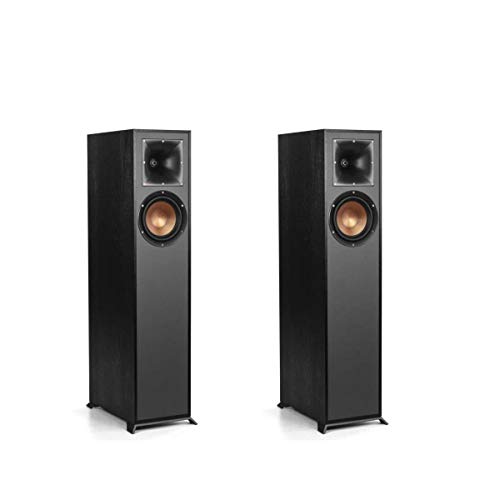
- 94dB sensitivity for efficient output
- 340-watt peak power handling
- 8-ohm impedance suits many receivers
Best For: Efficient movie and music playback
Horn-Loaded Home Theater Power – Klipsch RP-8000F II
For listeners seeking high sensitivity floorstanding speakers with dynamic home theater impact, the Klipsch RP-8000F II pair combines a larger 90° x 90° hybrid Tractrix horn with dual 8-inch Cerametallic woofers. Its passive design suits a traditional AV receiver or amplifier-based system.
Best For: Home theater listeners who want efficient, detailed sound and flexible bi-wiring or bi-amping options.
Pros:
- Larger hybrid Tractrix horn is designed for broad, controlled sound dispersion.
- Dual 8-inch Cerametallic woofers prioritize efficiency and low distortion.
- 1-inch LTS titanium diaphragm tweeter supports detailed high-frequency reproduction.
- Dual input terminals allow bi-wiring or bi-amping.
Cons:
- Passive speakers require a separate amplifier or AV receiver.
- The pair is relatively substantial at 60 pounds and requires floor space.
- They offer wired connectivity rather than built-in wireless streaming.
The RP-8000F II is a strong fit when sensitivity, output capability, and cinematic presentation matter more than compact size or all-in-one convenience. The walnut finish and removable grilles also make them suitable as visible front-stage speakers.
Wireless All-in-One Performance – KEF LS60 Wireless
The KEF LS60 Wireless is an active floorstanding system for buyers who want high sensitivity floorstanding speakers without assembling a separate amplifier setup. It combines precise Single Apparent Source imaging, integrated amplification, wireless streaming, and HDMI eARC for TV use.
Best For: Music and home theater listeners who want a streamlined, high-resolution wireless system with integrated bass.
Pros:
- Single Apparent Source technology is designed to create precise imaging and a cohesive soundstage.
- Built-in streaming supports Apple AirPlay 2, Chromecast, Spotify Connect, and TIDAL Connect.
- Four force-canceling bass drivers per speaker provide integrated low-frequency output without an external subwoofer.
- HDMI eARC, optical, coaxial, and RCA inputs support varied sources.
Cons:
- Active electronics mean less flexibility than a conventional passive speaker system.
- The system is heavy at 139 pounds according to the supplied specifications.
- Its two-year manufacturer warranty is shorter than some passive alternatives listed here.
Choose the LS60 Wireless when convenience and connectivity are central to the buying decision. It is especially compelling for users who want floorstanding scale, TV integration, and streaming in one coordinated system.
Down-Firing Bass Value – Fluance Reference XL8
The Fluance Reference XL8 pair offers a practical route to high sensitivity floorstanding speakers for stereo listening or home theater. Its three-way design combines down-firing 8-inch subwoofers, woven-fiber drivers, silk-dome tweeters, and a braced cabinet with dual rear ports.
Best For: Stereo and home theater buyers seeking deep bass, broad dispersion, and a complete passive speaker pair.
Pros:
- Down-firing 8-inch subwoofers provide deep low-frequency output while maintaining a clean footprint.
- Silk-dome neodymium tweeters are designed for crisp highs and spacious off-axis dispersion.
- Woven-fiber drivers target a detailed, controlled midrange.
- Includes floor spikes, magnetic grilles, and a lifetime full manufacturer’s direct warranty.
Cons:
- Passive operation requires a separate amplifier or receiver.
- Bluetooth is listed in the specifications, but the speakers use wired connectivity and a passive power source.
- Down-firing bass performance can depend on floor placement and room interaction.
The XL8 is a sensible choice for buyers who want substantial bass from a pair of towers without adding a separate subwoofer immediately. Its 35Hz–25kHz stated frequency range and three-way layout support both music and movie applications.
Low-Distortion Detail – KEF Q11 Meta
The KEF Q11 Meta is a passive tower for listeners comparing high sensitivity floorstanding speakers with an emphasis on clean, controlled detail. Its Metamaterial Absorption Technology, 12th-generation Uni-Q driver array, and dedicated hybrid aluminum bass drivers are designed to support a wide, precise listening presentation.
Best For: Home theater and music systems built around a preferred amplifier or AV receiver.
Pros:
- Metamaterial Absorption Technology absorbs 99% of rearward high-frequency noise according to the supplied product information.
- Uni-Q driver array is designed to expand the sweet spot and improve imaging.
- Dedicated hybrid aluminum bass drivers target tight, controlled low frequencies.
- CFD-optimized port and refined cabinet features support the overall tower design.
Cons:
- Passive design requires a separate amplifier or AV receiver.
- Its 4-ohm impedance may require careful amplifier matching.
- It is sold as an individual speaker, so a stereo setup requires two units.
The Q11 Meta is best suited to buyers building a system around component electronics rather than seeking wireless convenience. Its driver technology and noise-absorption design make it a strong candidate for focused music listening and detailed home theater playback.
High-Output Horn Power – Klipsch RP-8000F II
For listeners seeking high sensitivity floorstanding speakers for home theater, the Klipsch RP-8000F II pair emphasizes efficient, detailed sound and strong low-frequency output. Its larger 90° x 90° hybrid Tractrix horn, 1-inch titanium tweeter, and dual 8-inch Cerametallic woofers are designed to deliver clear performance with minimal distortion.
Best For: Home theater listeners who want an efficient stereo pair with substantial bass capability and flexible amplifier connections.
Pros:
- Larger 90° x 90° hybrid Tractrix horn supports efficient high-frequency dispersion.
- Dual 8-inch Cerametallic woofers provide high-output bass performance.
- 1-inch LTS titanium diaphragm tweeter is designed to minimize distortion.
- Dual terminals support bi-wiring or bi-amping.
Cons:
- The pair is relatively heavy at 61.4 pounds.
- Wired connections mean there is no wireless communication.
The RP-8000F II is the largest and most output-focused option in this group. Choose it when room-filling home theater sound, efficient operation, and customization through bi-amping matter more than compact size.
Audiophile Efficiency – Focal Aria K2 926
Focal Aria K2 926 Ash Grey (Limited Edition) 3-Way Floorstanding Audiophile Tower Speaker, (Pair)
Check Price On AmazonThe Focal Aria K2 926 is a strong candidate among high sensitivity floorstanding speakers, offering 91.5dB sensitivity alongside a three-way design and a stated response extending from 43Hz to 28kHz at ±3dB. Its K2 Sandwich cone and PowerFlow multi-port system target detailed, full-range home audio performance.
Best For: Audiophile-focused music and home audio setups that value a three-way tower design and efficient operation.
Pros:
- 91.5dB sensitivity supports efficient operation.
- Three-way floorstanding design separates driver duties.
- K2 Sandwich cone is a signature construction feature.
- PowerFlow multi-port system is included in the design.
Cons:
- Its listed low-frequency response is 43Hz at ±3dB, so deeper bass may require a subwoofer.
- Only wired connectivity is specified.
- The stated warranty is two years.
With its higher sensitivity and audiophile-oriented three-way architecture, the Aria K2 926 is the refined choice here. It suits listeners who prioritize musical detail and balanced tower performance over built-in wireless features.
Balanced Theater Value – Klipsch RP-6000F II
The Klipsch RP-6000F II pair combines high sensitivity floorstanding speakers with a more moderate 6.5-inch woofer configuration. Its 90° x 90° hybrid Tractrix horn and 1-inch LTS tweeter target crisp, low-distortion highs, while refined rear connections make adding Dolby Atmos speakers easier.
Best For: Home theater, gaming, and music systems that need efficient floorstanding sound without moving up to the larger 8-inch woofer model.
Pros:
- 90° x 90° hybrid Tractrix horn supports efficient high-frequency transfer.
- 1-inch LTS tweeter is designed for detailed, low-distortion performance.
- Dual 6.5-inch Cerametallic woofers balance output and cabinet size.
- Hidden Atmos connections and included jumpers simplify future upgrades.
Cons:
- Its 6.5-inch woofers offer less driver area than the RP-8000F II’s 8-inch woofers.
- Wireless connectivity is listed, but the speakers still use wired power and subwoofer connections.
The RP-6000F II is the practical middle ground: efficient, theater-friendly, and easier to integrate into an Atmos system. It is a sensible pick for listeners who want Klipsch’s horn-loaded presentation without the larger model’s extra woofer size.
Immersive Atmos Pick – Klipsch Reference R-26FA
The Klipsch Reference R-26FA is a practical option for shoppers seeking high sensitivity floorstanding speakers with an immersive home-theater focus. Its copper-spun IMG woofers, aluminum diaphragm compression drivers, and built-in elevation design support detailed stereo and surround presentations.
Best For: Home entertainment systems and listeners who want floorstanding speakers with an immersive surround-sound configuration.
Pros:
- Uses copper-spun IMG woofers and aluminum diaphragm compression drivers for detailed sound.
- Bass-reflex enclosure with a front-firing slot port supports impactful low-frequency output.
- MDF construction provides a durable cabinet with a classic black finish.
- Sold as a pair for straightforward stereo or surround-system setup.
Cons:
- Its 90-watt maximum output is lower than some higher-powered floorstanding alternatives.
- The speakers are wired and require a compatible corded-electric setup.
- They are not water resistant and are intended for indoor use.
Choose the R-26FA when immersive presentation and broad home-theater compatibility matter most. Its combination of horn-loaded detail, front-ported bass, and built-in elevation makes it a versatile pair for a dedicated entertainment setup.
High-Resolution Detail Pick – ELAC Debut 2.0 F6.2
The ELAC Debut 2.0 F6.2 suits buyers looking for high sensitivity floorstanding speakers in a serious two-channel or multi-channel system. Its 1-inch cloth-dome tweeter, waveguide, and triple 6.5-inch aramid-fiber woofers are designed for extended highs and controlled, full-range sound.
Best For: Music listeners and home-theater users who want a substantial wired tower with extended high-frequency response.
Pros:
- Cloth-dome tweeter extends response up to 35,000 Hz and uses a waveguide for directivity control.
- Triple 6.5-inch aramid-fiber woofers support stiffness, damping, and extended low-frequency response.
- Thick, internally braced MDF cabinets help reduce cabinet vibrations.
- Handles up to 140 watts and includes a three-year parts-and-labor warranty.
Cons:
- Sold individually, so a stereo pair requires purchasing two speakers.
- At 43.9 pounds each, these towers may be less convenient to move.
- There is no wireless communication technology.
The F6.2 is a strong choice when cabinet solidity, extended treble, and multi-driver bass performance take priority. Plan for a wired system and enough room for its large tower enclosure.
High-Sensitivity Value Pick – Klipsch Reference R-610F
The Klipsch Reference R-610F is a straightforward choice for shoppers comparing high sensitivity floorstanding speakers for music, movies, and surround sound. Its specified 94dB sensitivity, 8-ohm impedance, and 85-watt continuous power handling make it easy to match with many AV receivers.
Best For: Home entertainment systems that need efficient, room-filling output from a compatible AV receiver.
Pros:
- 94dB sensitivity helps deliver clear, efficient output.
- 1-inch aluminum LTS tweeter and 90-by-90-degree Square Tractrix Horn support crisp high frequencies.
- Handles 85 watts continuously and up to 340 watts peak.
- 8-ohm impedance supports integration with most AV receivers.
Cons:
- Its listed 45Hz-21kHz response may not reach as deeply in the bass as larger designs.
- Wireless functionality is not a substitute for the required wired speaker connection.
- The pair is relatively heavy at 90.2 pounds according to the supplied specifications.
The R-610F stands out for efficient output and receiver-friendly impedance rather than elaborate connectivity. It is a sensible pick for buyers who want a matching pair of Klipsch towers for energetic movie and music playback.
How We Picked the Best High Sensitivity Floorstanding Speakers
We focused on tower speakers that offer strong output, efficient amplifier use, and enough bass authority for serious two-channel or home theater listening. The selection includes passive and active designs, different cabinet sizes, horn-loaded and conventional tweeters, and models ranging from accessible options to premium audiophile towers.
We also considered practical factors such as sensitivity, impedance, driver configuration, bass extension, room-filling capability, connectivity, and whether a speaker is sold individually or as a pair. Because product specifications and availability can change, confirm the current listing before buying.
Quick Comparison
| Best For | Recommended Type | What to Prioritize |
|---|---|---|
| Home theater impact | Horn-loaded passive tower | High sensitivity, dynamic headroom, and matching center speaker |
| Simple all-in-one stereo | Active wireless floor speaker | Built-in amplification, streaming, inputs, and room correction |
| Music-focused listening | Three-way audiophile tower | Balanced voicing, imaging, cabinet quality, and bass control |
| Large rooms | Larger multi-driver tower | Output capability, impedance behavior, and low-frequency extension |
| Budget-conscious upgrades | Efficient entry-level tower | Value, placement flexibility, and subwoofer integration |
Key Buying Factors for High-Sensitivity Floorstanding Speakers
Sensitivity and Amplifier Matching
Higher sensitivity generally means a speaker can produce more volume from the same amplifier power. That makes efficient towers a good match for modest integrated amplifiers, tube amplifiers, and AV receivers. Still, sensitivity ratings are not perfectly standardized, so also check impedance and the amplifier’s recommended power range.
Horn Design and Treble Character
Horn-loaded tweeters can produce strong dynamics and precise projection, qualities that work well for movies and energetic music. Their tonal balance varies by design and room, so consider listening distance, room brightness, and toe-in options. Conventional dome tweeters may offer a smoother or more relaxed presentation depending on the speaker.
Room Size, Bass, and Subwoofer Use
Large towers with multiple woofers can energize bigger rooms, but they need adequate placement space. In smaller rooms, an oversized speaker may sound boomy if positioned too close to walls. A floorstanding speaker with controlled bass can also be the better choice if you plan to add a subwoofer and use a crossover.
Passive Versus Active Speakers
Passive speakers require an amplifier and allow future upgrades, while active models include amplification and often add wireless streaming, digital inputs, and room correction. Choose passive if system flexibility matters most; choose active if you want fewer components and a streamlined setup.
Who Should Buy Which High Sensitivity Floorstanding Speakers?
Choose a Klipsch Reference Premiere tower if you want high output, pronounced dynamics, and an excellent home theater foundation. Choose the KEF LS60 Wireless if you want premium sound with built-in amplification and modern streaming convenience.
Choose a larger three-way model from Focal, Fluance, KEF, or ELAC if music quality, broad soundstaging, and fuller bass are higher priorities than maximum sensitivity alone. Choose an entry-level Klipsch Reference tower if you want an efficient, affordable upgrade for movies and everyday listening.
Before ordering, confirm cabinet dimensions, included accessories, pair-versus-single-speaker packaging, amplifier compatibility, and return policies. Proper spacing from walls and careful toe-in can make as much difference as the speaker model itself.