Floorstanding speakers with front ports can deliver full, room-filling sound while giving you more flexibility when placement near a wall is unavoidable. The port design helps reduce some of the distance constraints associated with rear-ported towers, although room acoustics and spacing still matter.
This roundup compares 10 tower speakers across powered and passive designs, budget-friendly models, home theater options, and higher-performance stereo systems. Use the guide below to match cabinet size, bass output, amplification, and connectivity to your room and listening habits.
Best 10 Floorstanding Speakers with Front Ports Picks for 2026
Immersive Front-Port Atmosphere

- Front-firing slot port
- Copper-spun IMG woofers
- Pair for home theater
Best For: Immersive home entertainment setups
Powered Down-Firing Value
- 150W built-in amplifier
- RCA, optical, Bluetooth
- Down-firing bass ports
Best For: Simple, flexible powered stereo systems
High-Output Horn Detail

- Dual 6.5-inch woofers
- Tractrix Horn tweeter
- Rear-firing bass ports
Best For: Dynamic music, movie, and gaming playback
Wide-Band Three-Way Value
- Three-way, four-driver design
- Up to 50 kHz reproduction
- Pair bundle for stereo
Best For: Affordable wired music and home theater
Deep-Bass Floorstanding Pick

- Down-firing 8-inch subwoofers
- Three-way passive speaker design
- Includes spikes and magnetic grilles
Best For: Stereo and home theater listeners seeking room-filling bass
High-Sensitivity Theater Choice
- Dual 8-inch Cerametallic woofers
- Titanium Tractrix horn tweeter
- Bi-wire and bi-amp capable
Best For: High-output home theater and hi-fi systems
Precision Stereo Tower

- Dual 8-inch woofers in a three-way design
- Focused woven-glass-fiber midrange
- Includes outriggers and isolation spikes
Best For: Detailed two-channel stereo and home theater listening
High-Efficiency Pick
- 94dB sensitivity for strong room-filling output
- Horn-loaded 1-inch tweeter for clear detail
- 340W peak power handling and 8-ohm impedance
Best For: Home theater and high-output music listening
Budget Home Theater Pick

- Dual 6.5-inch bass radiators add low-end weight
- Easy wired connection to AV receivers
- Supports expansion to a Polk 5.1 system
Best For: Entry-level home theater and gaming setups
Atmos-Ready Pair

- Triple 5-inch woofers for broad driver coverage
- Waveguide and 1-inch soft-dome tweeter
- Dolby Atmos ready for compatible systems
Best For: Stereo or surround setups needing a matched pair
Immersive Front-Port Atmosphere – Klipsch R-26FA
The Klipsch Reference R-26FA is a strong option for shoppers seeking floorstanding speakers with front ports and a more immersive home-theater presentation. Its front-firing slot port supports impactful bass, while the copper-spun IMG woofers and aluminum diaphragm compression drivers aim for detailed, dynamic sound. This listing includes a pair in a black MDF cabinet.
Best For: Home entertainment setups that prioritize immersive stereo or surround-style listening and front-facing bass output.
Pros:
- Front-firing slot port helps deliver powerful low-frequency response.
- Includes copper-spun IMG woofers and aluminum diaphragm compression drivers.
- Sold as a pair with a durable MDF cabinet and sleek black finish.
Cons:
- The supplied specifications list a 1-year limited warranty.
- These are corded, wired speakers rather than an all-in-one wireless system.
Choose the R-26FA if front-port placement and an immersive, high-output presentation are central to your setup. Its pair configuration and home-theater-oriented design make it a practical fit for larger entertainment systems.
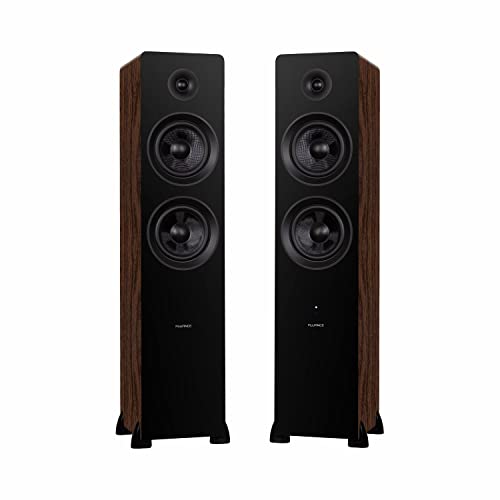
Powered Down-Firing Value – Fluance Ai81 Elite
The Fluance Ai81 Elite is a convenient alternative for shoppers comparing floorstanding speakers with front ports, although its bass ports fire downward rather than forward. The powered pair combines a built-in 150W amplifier with dual 6.5-inch woven glass-fiber drivers, so you can connect sources without a separate amplifier or receiver.
Best For: Music and movie listeners who want a complete powered stereo pair with flexible wired and Bluetooth connections.
Pros:
- Built-in 150W amplifier simplifies a 2.0 stereo setup.
- Offers RCA, optical, subwoofer output, and Bluetooth connectivity.
- Down-firing bass ports and dual 6.5-inch drivers support full-range playback.
- Includes a remote, speaker wire, and a 2-year manufacturer warranty.
Cons:
- The supplied notes specify down-firing ports, not front ports.
- Powered speakers require corded electrical power.
The Ai81 Elite is worth considering when convenience matters more than strict front-port placement. Its integrated amplification and broad input selection make it especially easy to build around a TV, turntable, computer, or Bluetooth device.
High-Output Horn Detail – Klipsch R-620F
Klipsch Reference R-620F Floorstanding Speaker, Black Textured Wood Grain Vinyl, Pair
Check Price On AmazonThe Klipsch Reference R-620F delivers a dynamic tower-speaker design for music, movies, and gaming. It is not a front-ported model—the supplied notes identify rear-firing Tractrix ports—but its dual 6.5-inch spun-copper IMG woofers, 1-inch aluminum LTS tweeter, and 100W/400W power handling target a lively, room-filling presentation.
Best For: Listeners who want detailed horn-loaded highs and strong bass from a traditional wired floorstanding pair.
Pros:
- Dual 6.5-inch woofers support deep, resonant bass.
- 90×90 square Tractrix Horn and aluminum LTS tweeter are designed to reduce distortion.
- 100W/400W power handling suits music, movies, and gaming.
- Black textured wood-grain vinyl and magnetic grilles provide a polished look.
Cons:
- The supplied notes specify rear-firing ports rather than front ports.
- The listing data is inconsistent about quantity, so verify whether the purchase includes a pair.
- It uses wired connectivity and has a 1-year limited warranty.
The R-620F is a better match for shoppers willing to trade front-port placement for Klipsch’s horn-loaded clarity and substantial power handling. Allow room behind the cabinets for the rear-firing ports to work as intended.
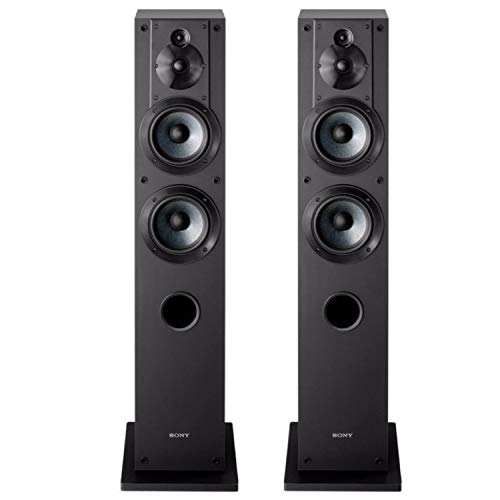
Wide-Band Three-Way Value – Sony SS-CS3
The Sony SS-CS3 is a three-way, four-driver floorstanding speaker aimed at home entertainment and music listening. The supplied notes do not identify a front port; instead, the design emphasizes a strong wood cabinet, a 1-inch polyester tweeter, a ¾-inch super tweeter, and sound reproduction up to 50 kHz. The listing describes a stereo pair bundle.
Best For: Budget-conscious listeners building a conventional wired stereo or home-theater system with high-resolution playback support.
Pros:
- Three-way, four-driver design separates the speaker’s output across multiple drivers.
- Includes a 1-inch main tweeter and ¾-inch super tweeter.
- 145W peak power and 6-ohm impedance are specified for system matching.
- Pair bundle supports a straightforward stereo setup.
Cons:
- The supplied notes do not confirm front ports.
- Connectivity is listed as auxiliary or wired rather than built-in amplification.
- The cabinet is relatively slim, so buyers seeking especially deep bass may prefer a dedicated subwoofer.
The SS-CS3 makes sense when you want a relatively affordable three-way tower pair and do not require confirmed front-port construction. Its driver layout and high-frequency specification give it a clear role in music and home-entertainment systems.
Deep-Bass Floorstanding Pick – Fluance Reference XL8FW
If you want floorstanding speakers with front ports but can work with a rear-ported design, the Fluance XL8FW offers a substantial alternative for stereo listening and home theater. Its down-firing 8-inch subwoofers aim to deliver deep bass while woven-fiber drivers and silk-dome tweeters cover the midrange and high frequencies.
Best For: Home entertainment setups that prioritize room-filling bass, detailed vocals, and a complete pair of passive towers.
Pros:
- Down-firing 8-inch subwoofers provide deep low-frequency output.
- Three-way design separates bass, midrange, and treble duties.
- Includes magnetic grilles, isolation spikes, and lifetime manufacturer support.
Cons:
- Uses dual rear ports rather than front ports.
- Its tall, nearly 46-inch cabinet requires significant floor space.
- Passive wired design requires a compatible amplifier or receiver.
The XL8FW is a practical choice when bass extension and an included stereo pair matter more than front-port placement. Its cabinet bracing and three-way driver arrangement further support a controlled, full-range presentation.
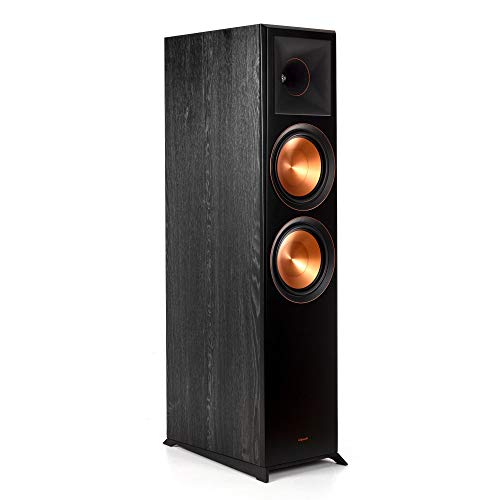
High-Sensitivity Theater Choice – Klipsch RP-8000F
Shoppers specifically seeking floorstanding speakers with front ports should note that the Klipsch RP-8000F uses a rear-firing Tractrix port instead. This single tower pairs dual 8-inch spun-copper Cerametallic woofers with a 1-inch titanium vented tweeter and hybrid Tractrix horn for a forceful home theater or hi-fi presentation.
Best For: Buyers building a Klipsch-based home theater or high-output two-channel system and needing one substantial tower speaker.
Pros:
- Dual 8-inch woofers support powerful low-frequency performance.
- Horn-loaded titanium tweeter is designed for clear, projecting highs.
- Dual binding posts allow bi-wire or bi-amp connections.
- Removable magnetic grille offers a clean, flexible appearance.
Cons:
- Sold as one speaker, not a pair.
- Rear-firing port needs reasonable clearance from the wall.
- Large cabinet weighs about 60 pounds.
The RP-8000F is better suited to listeners who value Klipsch’s horn-and-woofer approach than those who require front-port placement. Confirm your amplifier, space, and quantity needs before buying.
Precision Stereo Tower – Fluance Signature HFF
Although the Fluance Signature HFF is not a front-ported model, it is worth considering alongside floorstanding speakers with front ports when accurate two-channel sound is the priority. This passive three-way pair combines dual 8-inch woofers, a woven-glass-fiber midrange, and a high-end neodymium tweeter in acoustically inert MDF cabinets.
Best For: Stereo listeners and home theater builders who want a matched pair with controlled bass, detailed imaging, and substantial cabinet construction.
Pros:
- Dual 8-inch woofers target deep, controlled bass.
- Pointed-dome midrange design supports a focused soundstage.
- Thick front baffle and chamfered edges help reduce diffraction.
- Includes outriggers, isolation spikes, magnetic grilles, and lifetime support.
Cons:
- Does not use front ports, so placement flexibility may be limited.
- Tall, wide cabinets take up considerable room.
- Passive speakers require a separate amplifier or receiver.
The HFF stands out as a feature-rich stereo pair for buyers who value cabinet rigidity and driver integration. Its included stabilizers and spikes are useful additions for a carefully positioned listening setup.
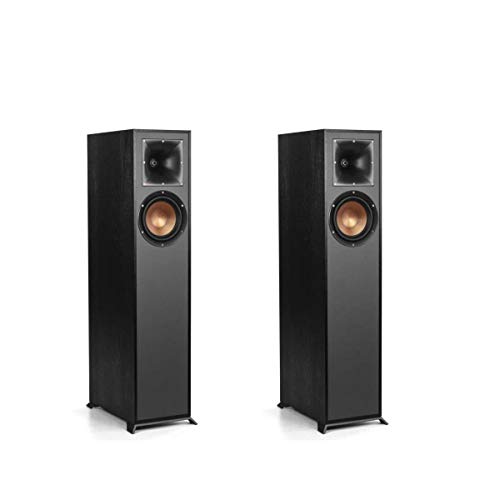
High-Efficiency Pick – Klipsch R-610F
The Klipsch Reference R-610F is a strong option if you want floorstanding speakers with front ports and an energetic presentation for movies, music, and surround sound. Its 94dB sensitivity, horn-loaded tweeter, and substantial power handling make it well suited to filling a room without demanding an unusually powerful receiver.
Best For: Home theater listeners and music fans who want high sensitivity, crisp treble, and robust output.
Pros:
- 94dB sensitivity supports clear, room-filling playback.
- 1-inch aluminum LTS tweeter and 90 x 90 Square Tractrix Horn help reveal dialogue and detail.
- 85W continuous and 340W peak power handling accommodate dynamic content.
- 8-ohm impedance works with most AV receivers.
Cons:
- Its 45Hz lower frequency response may leave the deepest bass to a separate subwoofer.
- This listing is a pair, so it may be more speaker than needed for a single-channel upgrade.
The R-610F is a practical choice when sensitivity and dynamic impact matter most. Add a subwoofer if you want more low-end extension for action films or bass-heavy music.
Budget Home Theater Pick – Polk Audio T50
The Polk Audio T50 is an accessible choice for shoppers considering floorstanding speakers with front ports for a straightforward home theater or stereo setup. Its 1-inch tweeter, 6.5-inch driver, and dual bass radiators are designed to produce balanced sound with added low-end presence.
Best For: First-time home theater builders, casual music listeners, and gamers seeking an easy-to-connect tower speaker.
Pros:
- Dual 6.5-inch bass radiators add deeper, room-filling bass.
- 1-inch tweeter and Dynamic Balance driver target crisp highs and detailed mids.
- Simple speaker-wire connection works with most home theater AV receivers.
- Can be expanded into a Polk 5.1 setup with matching center, surround speakers, and subwoofer.
Cons:
- The listed 150W maximum output is lower than some higher-output tower options.
- This listing contains one tower speaker rather than a pair.
- A separate subwoofer may still be useful for the deepest bass.
The T50 makes sense as a low-complexity starting point. Its radiator-assisted design provides useful bass support, while the upgrade path makes it easier to build a complete Polk-based system over time.
Atmos-Ready Pair – Jamo Studio S809
The Jamo Studio Series S809 is a versatile pair for shoppers comparing floorstanding speakers with front ports for stereo or surround sound. Three 5-inch aluminized polyfiber woofers, a soft-dome tweeter, and Dolby Atmos readiness give this slim tower design a useful mix of detail and home theater flexibility.
Best For: Stereo listeners and home theater users who want a matched pair with Atmos-ready design features.
Pros:
- Triple 5-inch aluminized polyfiber woofers provide full-range driver coverage.
- 1-inch soft-dome tweeter and waveguide technology support clear high frequencies.
- Dolby Atmos ready for compatible home theater configurations.
- 8-ohm impedance suits many conventional wired systems.
Cons:
- The listed 120W maximum output is more modest than some larger tower speakers.
- The supplied notes do not specify a frequency-response range.
- Deep bass performance may benefit from a separate subwoofer in larger rooms.
The S809 is a compelling pair when system flexibility matters more than maximum output. Its three-woofer layout and Atmos-ready construction make it a natural fit for a compact stereo or surround upgrade.
How We Picked the Best Floorstanding Speakers with Front Ports
We focused on tower speakers that use front-firing bass ports or otherwise offer placement-friendly designs, then compared the features most relevant to real-world buyers. Our evaluation criteria included driver configuration, claimed power handling or built-in amplification, bass capability, cabinet size, connection requirements, stereo and home theater suitability, and overall value.
Because specifications vary between manufacturers, listed wattage should be treated as a comparison point rather than a direct guarantee of loudness or sound quality. Room size, amplifier matching, listening distance, and speaker positioning can have an equally significant effect.
Quick Comparison
| Best For | Look For | Typical Choice |
|---|---|---|
| Simple TV or music setup | Built-in amplification and easy inputs | Powered tower speakers |
| Traditional home theater | Passive design and receiver compatibility | Matched left-right towers |
| Stronger bass without a subwoofer | Larger woofers and substantial cabinets | Three-way towers |
| Affordable full-range sound | Efficient drivers and sensible cabinet size | Entry-level tower pairs |
Key Buying Factors for Floorstanding Speakers with Front Ports
Powered or Passive?
Powered speakers include an internal amplifier and can connect directly to a TV, streamer, or source component, making them convenient for two-channel systems. Passive models require an AV receiver or stereo amplifier but offer broader upgrade flexibility and easier integration into surround-sound systems.
Port Placement and Room Positioning
Front ports can be more forgiving when a speaker must sit close to a rear wall, but they do not eliminate placement considerations. Leave space around the cabinet when possible, keep the left and right speakers symmetrical, and avoid blocking the port with furniture or thick material.
Drivers, Bass, and Room Size
Larger woofers and multiway designs can produce deeper, more authoritative bass, but they also tend to work best in medium or large rooms. Smaller towers may be easier to blend and position in compact spaces. If you plan to add a subwoofer, prioritize smooth midrange, imaging, and receiver compatibility over maximum bass extension.
Amplifier Matching and Connections
Check impedance, sensitivity, recommended amplifier power, and available inputs before buying. Confirm whether the speaker is sold individually or as a pair, especially when building a stereo system. For home theater, also verify compatibility with your center, surround, and subwoofer choices.
Who Should Buy Which Floorstanding Speakers with Front Ports?
Choose a powered tower if you want the simplest route to stereo music or TV sound with fewer components. Choose a passive pair if you already own an AV receiver, expect to expand into surround sound, or want the freedom to change amplification later. Budget-oriented shoppers should compare complete pairs and real connection needs, while serious music listeners may prefer larger three-way towers with stronger cabinet construction and wider dynamic range.
Whichever model you select, prioritize a return policy, measure your available space, and confirm the exact port location and included accessories before ordering.