In a large home theater, the center channel does much of the work for dialogue, vocals, and on-screen effects. The right model can keep voices clear and anchored to the screen even when the room, seating area, and soundtrack demand more output.
We compared 10 center channel speakers across Klipsch, Polk Audio, JBL, and ELAC, covering high-output designs, slim options, budget-friendly models, and speakers suited to larger front-stage systems.
Best 10 Center Channel Speakers for Large Rooms Picks for 2026
High-Output Dialogue

- Large 90° x 90° Tractrix horn
- Four 5.25-inch Cerametallic woofers
- Braced, divided cabinet design
Best For: Large-room theaters needing strong dialogue and high output
Room-Filling JBL Sound

- Quad 4.5-inch polycellulose woofers
- Precision 2.5-way crossover
- Dual rear-firing tuned ports
Best For: Home theaters wanting a high-power, driver-rich center speaker
Clear Dialogue Value
- 90° x 90° Tractrix horn
- 1-inch LTS aluminum tweeter
- Tapered-array crossover
Best For: Wide-seating theaters seeking clear dialogue in a slimmer cabinet
Slim Wall-Mount Design
Polk Audio Signature Elite ES35

- Six 3-inch woofers
- Power Port bass technology
- Shelf or wall-mount placement
Best For: Space-conscious large-room theaters needing flexible installation
Balanced Room-Filling Detail

- Dual 6.5-inch aramid-fiber woofers
- Wide-dispersion aluminum dome tweeter
- Sealed, braced cabinet for flexible placement
Best For: Larger home theaters needing detailed dialogue and substantial low-frequency support
High-Efficiency Dialogue Focus

- 90° x 90° Tractrix horn for clear dialogue
- Four efficient Cerametallic woofers
- Shallow sealed cabinet for flexible placement
Best For: Movie-heavy large-room systems prioritizing projected vocals and installation versatility
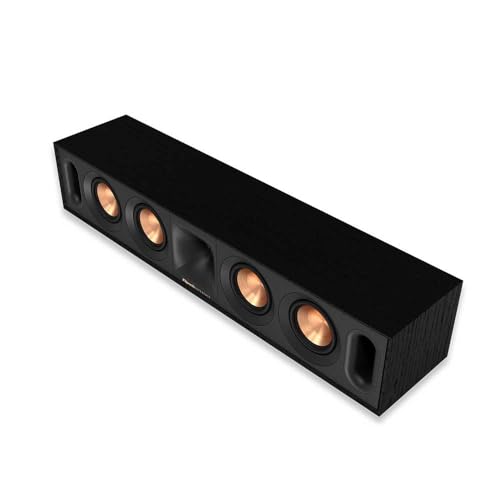
Slim Large-Room Placement

- Low-profile design helps avoid blocking the TV
- Four 3-inch woofers with a 1-inch tweeter
- Wall-mountable and Dolby Atmos compatible
Best For: Large rooms with limited space below the television or a preference for wall mounting
Premium Large-Room Clarity
Klipsch RP-500C Reference Premiere

- Dual 5.25-inch Cerametallic woofers
- Titanium tweeter with Hybrid Tractrix Horn
- 100-watt maximum output; 8-ohm impedance
Best For: Detailed Klipsch-based home theaters
Easy Home-Theater Upgrade
- Dual 5.25-inch woofers and silk dome tweeter
- Tuned rear port for punchy bass
- 100-watt maximum output; shelf-mount design
Best For: First home-theater systems and Polk T-Series setups
High-Sensitivity Dialogue
- Dual 5.25-inch spun-copper IMG woofers
- 90-by-90-degree Tractrix Horn
- 95dB sensitivity and 400-watt listed handling
Best For: Efficient Klipsch 5.1 home-theater systems
High-Output Dialogue – Klipsch RP-504C II
For center channel speakers for large rooms, the Klipsch Reference Premiere RP-504C II emphasizes clear, powerful dialogue through a larger 90° x 90° Tractrix horn, four 5.25-inch woofers, and a robust cabinet design. Its wide 32.06-inch cabinet makes it a strong fit for spacious home theater setups, provided you have enough shelf or stand space.
Best For: Large-room home theaters that prioritize forceful dialogue, detailed highs, and efficient output.
Pros:
- Larger Tractrix horn is designed to improve dialogue clarity and directivity.
- Four Cerametallic woofers and Tractrix ports support powerful, cleaner bass.
- Braced cabinet and divided enclosure help minimize vibrations.
- Magnetic removable grille provides flexible styling.
Cons:
- At 32.06 inches wide and 36 pounds, it requires substantial placement space.
- Wired tabletop mounting limits placement flexibility.
The RP-504C II is the most substantial option in this group, pairing high-efficiency Klipsch design with a large enclosure. It is especially compelling when your room and furniture can accommodate its width.
Room-Filling JBL Sound – JBL Stage 245C
The JBL Stage 2 245C is a practical contender among center channel speakers for large rooms, using four 4.5-inch polycellulose woofers, a precision 2.5-way crossover, and dual rear-firing tuned ports. Its high stated power handling suits a lively home theater system, while the espresso finish adds a furniture-friendly touch.
Best For: Home theater owners seeking a high-power center speaker with a broad woofer array and tuned-port design.
Pros:
- Quad 4.5-inch woofers provide a substantial driver array for center-channel duties.
- 2.5-way crossover is designed for controlled integration across the drivers.
- HDI horn and anodized aluminum tweeter support detailed high frequencies.
- Dual rear-firing tuned ports help support bass output.
Cons:
- Its listed dimensions are unusually tall at 29.1 inches, so placement should be measured carefully.
- Shelf mounting may require a sturdy, appropriately sized surface.
With its four-woofer layout and 150-watt stated maximum output, the Stage 245C is built for an assertive presentation. Confirm the listed dimensions before buying, especially if the speaker will sit below a television.
Clear Dialogue Value – Klipsch R-30C
The Klipsch R-30C is a streamlined choice for center channel speakers for large rooms, combining a 90° x 90° Tractrix horn with a 1-inch aluminum tweeter and dual 3.5-inch TCP woofers. Its tapered-array crossover is intended to improve dispersion and midrange definition, helping dialogue remain intelligible across wider seating positions.
Best For: Large-screen home theaters that need focused dialogue clarity in a relatively low-profile cabinet.
Pros:
- 90° x 90° Tractrix horn supports broad directivity and a natural presentation.
- LTS aluminum tweeter is designed to reduce distortion and improve detail.
- Tapered-array crossover helps improve dispersion and midrange definition.
- Magnetic grille and hidden fasteners create a clean, modern appearance.
Cons:
- Its two 3.5-inch woofers are smaller than the driver arrays on the larger alternatives.
- The 25.98-inch width still requires dedicated shelf or console space.
The R-30C offers Klipsch’s horn-loaded approach in a more approachable format than the RP-504C II. It is a sensible pick when dialogue dispersion matters but your setup does not require the largest available center cabinet.
Slim Wall-Mount Design – Polk Audio Signature Elite ES35
The Polk Audio Signature Elite ES35 is a slim center speaker for large rooms, using six 3-inch woofers, a 1-inch Terylene tweeter, cascading crossovers, and Power Port technology. Its wall-mount option can be useful below a television, while the low-profile design helps preserve sightlines in space-conscious theater rooms.
Best For: Large-room systems needing a slim, wall-mountable center channel with broad placement flexibility.
Pros:
- Six 3-inch woofers create a compact but substantial driver array.
- Power Port technology is designed to support cleaner, more impactful bass.
- Wall mounting below a television can help avoid blocking the screen or IR sensor.
- Compatible with 4- and 8-ohm systems and suited to movies, gaming, and multi-channel music.
Cons:
- Its 20-inch width and 7.5-inch height may still be too large for some narrow media consoles.
- The slim cabinet uses smaller 3-inch woofers than several competing models.
The ES35 stands out when installation flexibility is as important as output. Its six-woofer layout and wall-mount capability make it a strong fit for modern rooms where a conventional deep center speaker would be inconvenient.
Balanced Room-Filling Detail – ELAC Debut 3.0 DC63-BK
For shoppers comparing center channel speakers for large rooms, the ELAC Debut 3.0 DC63-BK offers a substantial dual-woofer design, clear high-frequency reproduction, and a sealed cabinet that remains flexible near a wall or inside a cabinet.
Best For: Home theater listeners who want detailed dialogue and a larger center speaker that is still relatively easy to drive.
Pros:
- Dual 6.5-inch aramid-fiber woofers support extended low-frequency response.
- Aluminum dome tweeter and redesigned waveguide provide clear detail and wider dispersion.
- Sealed cabinet and internal bracing support flexible placement and reduced cabinet vibration.
- 6-ohm impedance and efficient design work with a broad range of amplifiers.
Cons:
- Its 21-inch depth and nearly 8-inch height require substantial shelf or cabinet space.
- Wired tabletop placement may be less convenient than a wall-mountable design.
The DC63-BK is a strong fit when a larger room and broad seating area call for a physically substantial center speaker. Its sealed construction also makes placement easier when the speaker must sit close to a rear wall.
High-Efficiency Dialogue Focus – Klipsch RP-404C II Walnut
Among center channel speakers for large rooms, the Klipsch Reference Premiere RP-404C II emphasizes clear, projected dialogue through its larger Tractrix horn and efficient Cerametallic woofer system, while its shallow sealed cabinet accommodates tighter installations.
Best For: Movie-focused systems where crisp vocals, high efficiency, and flexible placement near a wall or fireplace mantle matter most.
Pros:
- 90° x 90° Tractrix horn is designed for crisper, clearer dialogue.
- 1-inch vented LTS titanium diaphragm tweeter helps minimize distortion.
- Four Cerametallic woofers deliver efficient sound reproduction.
- Shallow sealed design supports in-wall placement and reduces bass loading against a back wall.
Cons:
- Its 87Hz listed frequency-response specification suggests less deep bass extension than larger full-range center designs.
- The 26.85-inch width may be difficult to fit in compact media furniture.
The RP-404C II is particularly appealing for large-room movie setups where intelligible dialogue must carry across the seating area. Its shallow sealed enclosure adds installation flexibility without giving up the distinctive horn-loaded presentation.
Slim Large-Room Placement – Polk Monitor XT35 Slim Center
The Polk Monitor XT35 is a practical option for shoppers seeking center channel speakers for large rooms without blocking the television. Its slim enclosure combines a 1-inch terylene tweeter with four 3-inch woofers and supports wall mounting below the display.
Best For: Space-conscious home theaters that need a low-profile center speaker with Dolby Atmos and DTS:X compatibility.
Pros:
- Low-profile 4-inch design helps keep the television view and IR sensor unobstructed.
- Four dynamically balanced 3-inch woofers provide an open midrange and impactful bass.
- 1-inch terylene tweeter and Hi-Res Audio certification support detailed playback.
- Wall-mountable design and 4- and 8-ohm compatibility add system flexibility.
Cons:
- Smaller woofers may offer less physical scale than the larger-driver ELAC design.
- Its 24-inch width still requires a reasonably wide mounting surface.
The XT35 makes the most sense when placement constraints are as important as output. Its slim profile, wall-mounting option, and broad compatibility can simplify a large-room setup where a deeper center speaker would interfere with the display.
Premium Large-Room Clarity – Klipsch RP-500C Reference Premiere
For center channel speakers for large rooms, the Klipsch RP-500C combines dual 5.25-inch Cerametallic woofers with a 1-inch titanium LTS vented tweeter and Hybrid Tractrix Horn. Its 100-watt maximum output, 8-ohm impedance, and 18.9-inch width make it a strong choice for a detailed home-theater front stage.
Best For: Home-theater listeners who want horn-loaded dialogue detail and a premium ebony finish.
Pros:
- Dual 5.25-inch spun-copper Cerametallic woofers support clear, full center-channel output.
- Titanium LTS vented tweeter and Hybrid Tractrix Horn emphasize detailed high frequencies.
- Rear-firing Tractrix port supports bass-reflex performance.
- Removable magnetic grille and scratch-resistant ebony finish provide a polished appearance.
Cons:
- Its rear-firing port may require some clearance from the wall.
- At 17.6 pounds, it is relatively substantial for shelf or wall placement.
The RP-500C is the most premium-looking option here and offers the strongest specification set for a large-room setup, particularly when paired with a compatible Klipsch system.
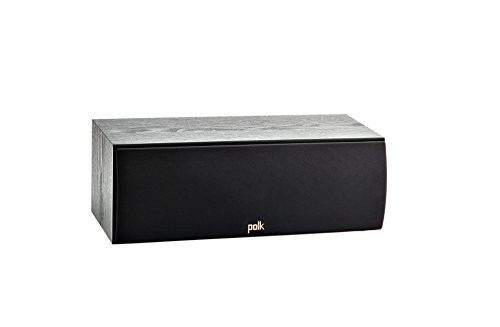
Easy Home-Theater Upgrade – Polk Audio T30 Center Channel
The Polk Audio T30 is a practical pick among center channel speakers for large rooms, using dual 5.25-inch woofers and a 1-inch silk dome tweeter for dialogue and midrange clarity. Its tuned rear port and 100-watt maximum output make it suitable for movies, music, gaming, and straightforward AV-receiver setups.
Best For: First-time home-theater builders and listeners seeking an affordable, easy-to-connect center speaker.
Pros:
- Dual 5.25-inch woofers deliver full-range sound and punchy bass.
- One-inch silk dome tweeter supports crisp dialogue and vocal clarity.
- Timbre-matched design integrates with Polk T-Series speakers.
- 19-inch width and shelf-mount design fit many entertainment centers.
Cons:
- The 6-ohm impedance may require checking receiver compatibility.
- Its black wood enclosure is less visually distinctive than the Klipsch alternatives.
With a five-year parts-and-labor warranty and simple wired setup, the T30 is a sensible value option for building a larger-room system without complicated installation.
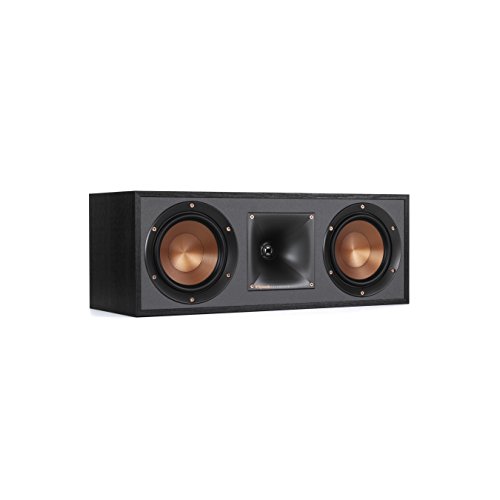
High-Sensitivity Dialogue – Klipsch R-52C Center Channel
The Klipsch R-52C is a compelling option among center channel speakers for large rooms, pairing dual 5.25-inch spun-copper IMG woofers with a 1-inch aluminum LTS tweeter and 90-by-90-degree Tractrix Horn. Its listed 95dB sensitivity is designed for efficient, detailed playback in a 5.1 home-theater system.
Best For: Klipsch system owners who prioritize efficient output and horn-loaded dialogue presentation.
Pros:
- Dual spun-copper IMG woofers support strong center-channel presence.
- Aluminum LTS tweeter with Kapton suspension adds detailed high-frequency reproduction.
- 90-by-90-degree Tractrix Horn and 95dB sensitivity suit energetic home-theater playback.
- 400-watt listed power handling provides substantial headroom.
Cons:
- The stated 89Hz–21kHz response leaves more low-frequency duties to a subwoofer.
- Its floor-standing mounting designation may be less flexible for compact media consoles.
The R-52C emphasizes efficient, lively output and is a good match for a Klipsch-centered 5.1 system, especially where clear front-stage dialogue matters.
How We Picked the Best Center Channel Speakers for Large Rooms
We focused on the factors that matter most in a spacious listening area: dialogue clarity, output capability, cabinet and driver configuration, sensitivity, compatibility with matching front speakers, and practical placement. We also considered whether each speaker is easy to integrate with an AV receiver and subwoofer.
A large room does not automatically require the biggest center channel available. Seating distance, listening volume, crossover settings, and the size of the left and right speakers all affect the best choice. The models in this roundup represent several sensible approaches rather than one universal design.
Quick Comparison
| What to prioritize | Best suited to |
|---|---|
| High sensitivity and larger drivers | Large rooms and higher playback levels |
| Wide horizontal coverage | Multiple seats across a broad sofa |
| Slim cabinet design | Placement below a TV or behind an acoustically transparent screen |
| Matching series and tonal character | Systems built around the same speaker family |
| Lower price and compact size | Entry-level or moderate-volume home theaters |
Key Buying Factors for Center Channel Speakers for Large Rooms
Output, Sensitivity, and Room Size
Choose a speaker that can produce clean dialogue at your normal listening distance without sounding strained. Higher sensitivity can make a speaker easier for an AV receiver to drive, while larger woofers or multiple drivers may provide more effortless output. Room dimensions and seating distance matter more than a simple wattage rating.
Driver Layout and Dispersion
Look for a design that maintains consistent dialogue across the seating area. Multi-driver models can offer useful output and broad coverage, but horizontal center speakers can vary in off-axis performance. If several listeners sit far to either side, prioritize proven dispersion and avoid hiding the speaker inside a cabinet.
System Matching and Placement
For the most seamless front soundstage, match the center to the same product series as your left and right speakers when possible. Place it as close to ear level as practical, angle it toward the seats if necessary, and leave the front of the cabinet unobstructed. Set the crossover through your receiver rather than relying on the center to reproduce deep bass.
Size, Clearance, and Finish
Measure the available shelf, stand, or screen location before buying. A large center can deliver useful headroom but may block a TV or require a dedicated stand. Slim models are easier to position, while larger cabinets may be the better fit for high-output systems.
Who Should Buy Which Center Channel Speakers for Large Rooms?
Choose a high-output Klipsch Reference Premiere or comparable large-driver model if you watch action films at elevated volume or sit well back from the screen. A model from the same brand and series as your front speakers is usually the safest choice for consistent timbre.
Consider a Polk Signature Elite, Polk Monitor XT, or similar slim design when placement flexibility and broad seating coverage matter most. ELAC and JBL options are worth considering when you want a different tonal balance or are building around those brands.
For smaller budgets or moderate listening levels, the Polk T30 and Klipsch R-52C can provide a practical dialogue-focused upgrade. Regardless of price, proper placement, receiver calibration, and a clear path to the listening area will have a major effect on performance.